Publication Type
Working Paper
Keywords
Wood Timber Forestry
Bilingual Publication • Édition Bilingue

This publication is officially available in both English and French (Français) editions.

Available Downloads

Abstract

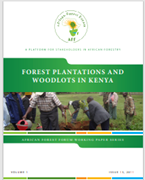
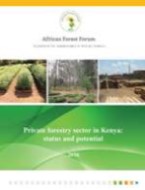
Kenya has a total surface area of 582 646 km², and a population total of just over 40 million with a growth rate of 2.7% (2009 census). The total state forest area is estimated at 2.35 million ha (about 2.7% of Kenya's land area) out of which 1.57 million ha are gazetted and 0.78 million ha ungazetted forests. In addition, there is approximately 2.1 million ha of other woodlands, 24.8 million ha of bush land and 10.7 million ha of wooded grassland. The number and volume of trees on farm are considerable in Kenya, particularly on small- and medium size farms in the highlands, but it is impossible to translate these tree resources into an area equivalent figure.

Publication Downloads

🌐 Bilingual Edition · English & French Available

Access and download the official document in available languages.

🇬🇧 EN

English Edition

PDF Document · 1.1 MB

Download PDF
🇫🇷 FR

Édition Française

Document PDF · 1.1 MB

Télécharger PDF
Publication Type
Working Paper
Keywords
Biofuel Climate change Forestry
Bilingual Publication • Édition Bilingue

This publication is officially available in both English and French (Français) editions.

Available Downloads

Abstract

The Congo Basin (CB) forest is highly rich in biodiversity and contain mineral deposits of economic importance. The forest is under threat as a result of human activities including: agriculture (slash and burn and agro-industry plantations), mining, logging, infrastructural development, fuelwood extraction. Underlying factors that pose threat to the forest cover include: demographic pressure, political instability, weak governance and institutional arrangements and the quest for economic growth. The forest cover has witnessed a change over the last three decades. The deforestation rate for the CB forest between 1990 and 2000 was estimated at 0.09% while the forest degradation rate for the same period was estimated at 0.05%. Between 2000 and 2005, the deforestation and forest degradation rates of the region was estimated at 0.17% and 0.09% respectively. Of the CB countries, the Democratic Republic of Congo (DRC) has the highest rate of deforestation and forest degradation while Equatorial Guinea emerged as the country with the least deforestation rate.

Publication Downloads

🌐 Bilingual Edition · English & French Available

Access and download the official document in available languages.

🇬🇧 EN

English Edition

PDF Document · 1.5 MB

Download PDF
🇫🇷 FR

Édition Française

Document PDF · 1.5 MB

Télécharger PDF
Publication Type
Journal Article
Keywords
Forestry Workshop Management
Bilingual Publication • Édition Bilingue

This publication is officially available in both English and French (Français) editions.

Available Downloads

Abstract

Forests in Africa support the livelihoods of millions of people through provision of timber and non-timber forest products, food and nutrition, energy and payment of environmental services. However, mismanagement of forests has resulted in deforestation and forest degradation, thereby contributing to the increased emission of carbon dioxide into the atmosphere. This special issue highlights some of the research outcomes presented at a pre-congress workshop organised by the African Forest Forum and partners at the 2015 World Forestry Congress. In this issue, the main drivers of land degradation are highlighted vis-à-vis population growth, agricultural expansion, climate variability, drought and energy needs. Promising traditional management practices are identified including age-old farmer-managed natural regeneration and exclosures. In addition, research presented indicates that age-old systems such as native non-browse shrubs in Ethiopia are important in that they facilitate regeneration of late-successional tree species. Furthermore, opportunities for using forests to mitigate climate change are highlighted with a case study on the economics associated with carbon markets. The issue also highlights the methodological challenges of quantifying carbon in African forests. The effect of climate change on threatened forest species and biodiversity in general is discussed, and the associated human disturbances impacting on the population structure of a threatened species, e.g. Afzelia africana in West Africa, is presented. The important role of non-timber forest products in income generation for the rural communities and the associated challenges of commercialisation is emphasised with examples from two important tree species: shea (Vitellaria paradoxa) and baobab (Adansonia digitata). Finally, the issue covers a people-centred approach in tree planting and management where studies demonstrated that there are still problems of poor participation of local communities due to poor implementation of enabling policies, lack of involvement in initial planning and subsequent lack of clear benefit-sharing mechanisms.

Publication Downloads

🌐 Bilingual Edition · English & French Available

Access and download the official document in available languages.

🇬🇧 EN

English Edition

PDF Document · 1.7 MB

Download PDF
🇫🇷 FR

Édition Française

Document PDF

Télécharger PDF
Publication Type
Working Paper
Keywords
Forestry Woodlots Plantations
Bilingual Publication • Édition Bilingue

This publication is officially available in both English and French (Français) editions.

Available Downloads

Abstract

Rwanda is a small, landlocked country in Central Eastern Africa. It is located between latitudes 104' and 2051' South and longitudes 28045' and 31015' East. The territory of Rwanda covers a surface area of 26 338 km2. It borders four countries, viz. the Democratic Republic of Congo (DRC), Burundi, Uganda and Tanzania (Figure 1). The population was estimated at 10.1 million people in 2009 (NISR, 2010) and, therefore, the average population density is 384 people per km2, which is one of the highest in the world. The physiological density (people per area of arable land) is even higher, well in excess of 500 people per km2 (UNDP and UNEP, 2006).

Publication Downloads

🌐 Bilingual Edition · English & French Available

Access and download the official document in available languages.

🇬🇧 EN

English Edition

PDF Document · 1.8 MB

Download PDF
🇫🇷 FR

Édition Française

Document PDF · 1.8 MB

Télécharger PDF
Publication Type
Compendium
Keywords
Climate change Forestry Atmosphere Data
Bilingual Publication • Édition Bilingue

This publication is officially available in both English and French (Français) editions.

Available Downloads

Abstract

A clear understanding of the basics of the science of climate change lays a foundation on the terms, definitions, and concepts used and their application in forestry science. This module will introduce learners to the key and basic concepts of the science of climate change. It is divided into five chapters: Physics and chemistry of environment; General ecology; Sustainable forest management; Processes, drivers and impacts of climate change; and Climate change data management

Publication Downloads

🌐 Bilingual Edition · English & French Available

Access and download the official document in available languages.

🇬🇧 EN

English Edition

PDF Document · 2.5 MB

Download PDF
🇫🇷 FR

Édition Française

Document PDF · 2.5 MB

Télécharger PDF
Publication Type
Compendium
Keywords
Climate change Forestry Weather Science
Bilingual Publication • Édition Bilingue

This publication is officially available in both English and French (Français) editions.

Available Downloads

Abstract

The science of climate change looks at how the Earth’s climate has changed over the years and the causes as well as the possible future changes which could result from human interference with the climate system. Understanding how climate influences society and how humans influence climate has become more urgent now than ever before. Information and knowledge generated and provided by climate change science forms the basis in shaping policies and agreements. The cross-cutting nature of the problems requires the engagement of everyone at all levels. It is therefore important to have some basic understanding of the science of climate change in order to appreciate the seriousness of the problem Chapter one of the this module explores the science of climate change. This involves a description of the concepts of weather and climate by clearly defining and differentiating between them. The elements of weather and climate are also well analyzed. The difference between the concept of climate variability and climate change is also discussed in detail. In addition, the types, sources and effects of of GHGs are discussed. Chapter two discusses the causes of climate change. Both natural and human-indiuced drivers of climate change are decribed in detail. Under natural drivers, aspects of volcanic eruptions and wildfire are discussed. Under antropogenic drivers, land use changes, use of fossils fuels and also the urbanization are discussed. Chapter three examines climate change and ecosystem. The disturbances of ecosystems under climate change are addressed. Various indicators of ecosystem disturbances are explained and also the challenges and opportunities of climate change on ecosystem. Chapter four focuses on vulnerability to and impact of climate change. Various approaches of vulnerability assessments are discussed and from this chapter it is clear to determine the extent of vulnerability,using socioeconomic or ecological assessments. Chapter five, finally, discusses the different UN conventions on the envrioment. It is important to note that these conventions play an important role in ensuring that environment is well maintained and protected from human induced actions. They are normally open for participation by the international community as a whole, or by a large number of States. This module covers five chapters as follows:
  •  Basics of Climate Change
  • Causes of Climate Change
  • Climate Change and Ecosystems
  • Vulnerability to and Impact of Climate Change
  • United Nations Conventions on the Environment

Publication Downloads

🌐 Bilingual Edition · English & French Available

Access and download the official document in available languages.

🇬🇧 EN

English Edition

PDF Document · 986 KB

Download PDF
🇫🇷 FR

Édition Française

Document PDF · 986 KB

Télécharger PDF
Publication Type
Working Paper
Keywords
Plantations Woodlots Forestry Species
Bilingual Publication • Édition Bilingue

This publication is officially available in both English and French (Français) editions.

Available Downloads

Abstract

Forest plantation development in the study countries of Burundi, Ethiopia, Kenya, Rwanda, Sudan, Tanzania and Uganda was, in most cases, preceded by species and provenance trials, mainly of exotic tree species, starting in the late 1800s in South Africa, then later in the early to mid 1900s in the rest of the region. Successful results from species and provenance trials led to large scale planting during the period 1920-1960, and also continued to broaden the species range and improve productivity of the various species.

Publication Downloads

🌐 Bilingual Edition · English & French Available

Access and download the official document in available languages.

🇬🇧 EN

English Edition

PDF Document · 1.1 MB

Download PDF
🇫🇷 FR

Édition Française

Document PDF · 1.1 MB

Télécharger PDF
Publication Type
Policy Brief
Keywords
Forest Forestry
Bilingual Publication • Édition Bilingue

This publication is officially available in both English and French (Français) editions.

Available Downloads

Abstract

The African Forest Forum (AFF) in a study on professional forestry associations in southern Africa found out that a majority of formerly active professional forestry associations have gone moribund for several reasons. However, South Africa is the exception in that it has a number of active forest related associations that are backed by a vigorous industrial base. They are well placed to influence public policies in support of the forestry sector. In addition, several countries including Mozambique, Zambia and Zimbabwe have associations of producers, traders and manufactures of forest products. Despite this, there is tremendous interest in virtually every country to strengthen, revive or establish new professional forestry associations; largely motivated by the income generation and poverty reduction 'policy push' in virtually every country; and more recently, the new opportunities in forestry to reduce CO2 emissions under REDD+ (Reducing Emissions from Deforestation and forest Degradation) and Clean Development Mechanism (CDM) schemes. The AFF considers it an opportune moment to strengthen, establish or revive both professional and industry associations in a continent that is increasingly becoming aware of the potential role of forests and trees, their contribution to national incomes, livelihoods, and stability of the environment.  

Publication Downloads

🌐 Bilingual Edition · English & French Available

Access and download the official document in available languages.

🇬🇧 EN

English Edition

PDF Document · 180 KB

Download PDF
🇫🇷 FR

Édition Française

Document PDF · 180 KB

Télécharger PDF
Publication Type
Working Paper
Author(s)
Keywords
Forestry Science Agriculture
Bilingual Publication • Édition Bilingue

This publication is officially available in both English and French (Français) editions.

Available Downloads

Abstract

Public private partnership as a concept has gained ground over the last few decades as a virile approach to delivering goods and services. It is a contractual agreement between a public agency and a private company or consortia of companies whereby the skills and assets of the public and private sectors are shared in delivering a service or facility. This concept has been successfully applied, particularly in infrastructure, as medium to long term arrangements between the public and private sectors in the provision of some service obligations of the public sector by the private sector, with clear agreement on shared objectives for delivery of public infrastructure and/ or public services, as well as benefit sharing. The forest sector had for a long time operated as a public sector concern, with sporadic private involvements. However, in recent years, public-private sector forestry development has emerged as a new world-wide practice for forestry development. The issuance of the World Bank Forest Sector Policy Paper in 1978 also propelled major changes in direction away from support for industrial forestry to forestry that meets local needs. This approach further opened the vistas for private participation in different parts of the world. However, in most cases, there have not been clear arrangements in terms of shared vision and objectives, co-delivery of goods and services as well as cost and benefit sharing. While some advances have been made in Europe, America and parts of Asia in this regard, same may not be said of most of Sub-Saharan Africa, and in particular, Nigeria. The study whose results are shared in this report examined the idea and concept of publicprivate sector partnerships in the forest sector by identifying promising PPP models/approaches for forest compatible sustainable livelihoods development that strengthens the capacity of the industry to address both social and environmental concerns, and therefore contributing to more sustainable, equitable and effective private sector development.This study was undertaken in the High/Moist Forest, Savanna and Sahel zones of Nigeria, and more specifically it was carried out in the selected states of Lagos, Ogun, Oyo, Osun, Edo, Abia, Rivers, Cross Rivers, Niger, Kaduna, Kano and Kwara. The states were further stratified by agro-ecological as well as geo-political settings. Within these settings, study localities were selected across primary forest production, secondary forest production, (wood processing, marketing and trade) including SMEs based on all forest types in the country. 

Publication Downloads

🌐 Bilingual Edition · English & French Available

Access and download the official document in available languages.

🇬🇧 EN

English Edition

PDF Document · 2.2 MB

Download PDF
🇫🇷 FR

Édition Française

Document PDF

Télécharger PDF
Publication Type
Working Paper
Author(s)
Keywords
Sustainable development Forestry Partnerships Private Sector
Bilingual Publication • Édition Bilingue

This publication is officially available in both English and French (Français) editions.

Available Downloads

Abstract

Public private partnership as a concept has gained ground over the last few decades as a virile approach to delivering goods and services. It is a contractual agreement between a public agency and a private company or consortia of companies whereby the skills and assets of the public and private sectors are shared in delivering a service or facility. This concept has been successfully applied, particularly in infrastructure, as medium to long term arrangements between the public and private sectors in the provision of some service obligations of the public sector by the private sector, with clear agreement on shared objectives for delivery of public infrastructure and/ or public services, as well as benefit sharing. The forest sector had for a long time operated as a public sector concern, with sporadic private involvements. However, in recent years, public-private sector forestry development has emerged as a new world-wide practice for forestry development. The issuance of the World Bank Forest Sector Policy Paper in 1978 also propelled major changes in direction away from support for industrial forestry to forestry that meets local needs. This approach further opened the vistas for private participation in different parts of the world. However, in most cases, there have not been clear arrangements in terms of shared vision and objectives, co-delivery of goods and services as well as cost and benefit sharing. While some advances have been made in Europe, America and parts of Asia in this regard, same may not be said of most of Sub-Saharan Africa, and in particular, Nigeria. The study whose results are shared in this report examined the idea and concept of publicprivate sector partnerships in the forest sector by identifying promising PPP models/approaches for forest compatible sustainable livelihoods development that strengthens the capacity of the industry to address both social and environmental concerns, and therefore contributing to more sustainable, equitable and effective private sector development.This study was undertaken in the High/Moist Forest, Savanna and Sahel zones of Nigeria, and more specifically it was carried out in the selected states of Lagos, Ogun, Oyo, Osun, Edo, Abia, Rivers, Cross Rivers, Niger, Kaduna, Kano and Kwara. The states were further stratified by agro-ecological as well as geo-political settings. Within these settings, study localities were selected across primary forest production, secondary forest production, (wood processing, marketing and trade) including SMEs based on all forest types in the country. 

Publication Downloads

🌐 Bilingual Edition · English & French Available

Access and download the official document in available languages.

🇬🇧 EN

English Edition

PDF Document · 2.2 MB

Download PDF
🇫🇷 FR

Édition Française

Document PDF

Télécharger PDF