🗓️ Event & Workshop

Académie REDD+ -- Échange régional: Mécanismes de partage des bénéfices efficaces, justes et équitables pour la REDD+ en Afrique

📍 Venue / Regional Node 🌐 Pan-African Conference
Nov 21

Event Date & Time

November 21, 2025 · East Africa Time (EAT)

Overview & Agenda

Lusaka, Zambie
🗓️ Event & Workshop

REDD+ Academy Regional Exchange: Effective, just and fair benefit-sharing mechanisms for REDD+ in Africa

📍 Venue / Regional Node 🌐 Pan-African Conference
Nov 21

Event Date & Time

November 21, 2025 · East Africa Time (EAT)

Overview & Agenda

Lusaka, Zambia
Publication Type
Report
Keywords
Forest Private Sector
Bilingual Publication • Édition Bilingue

This publication is officially available in both English and French (Français) editions.

Available Downloads

Abstract

This study was aimed at producing information that will be used by relevant stakeholders in facilitating the development of public-private sector partnerships in forestry involved in value addition to wood and non-wood forest products in Southern African region; specifically for five countries: Madagascar, Mozambique, South Africa, Zambia, and Zimbabwe. Also, the study identifies promising public-private partnership (PPP) models/approaches for forest compatibility with sustainable livelihoods that addresses both social and environmental concerns and contribute to more sustainable, equitable and productive private sector development. The contribution of the forestry sector to livelihood support and national economy is significant. Forestry sector contributes to the country’s GDP varying from 0.8% (South Africa) to 5.7% (Zambia). The industry has considerable potential for employment and incomes at different levels. In total, in the Southern African region, there was estimated a total of 125 366 employees in primary forest production and 602 966 charcoal producers. In secondary forest production, the number of employees was estimated at 78 186. Since Madagascar, Mozambique and Zambia depend on indigenous forests for their wood products supply they are facing similar concerns. There are various wood and non-wood tree species of commercial importance whose stocks are declining. This underlines the need to manage the forest resources sustainably. Most of the forest resources in these countries are owned by the government. Actors in secondary forest production are mainly small and medium scale enterprises (SMEs) and large companies in the private sector; most of them are in the informal sector. In South Africa and Zimbabwe, most of the commercial forest estate is in private ownership (83% in South Africa). Landowners have property rights and full control over the land and forest resources on it, with limited statutory prohibitions such as felling of indigenous trees and land use changes. In Zimbabwe, the forest sector had had a history of primary and secondary growth, but capacity utilization fell below 20% resulting from power cuts, inadequate competent staff, and obsolete manufacturing plants. Actors are dominated by men, even though women are also increasing their participation in the sector. There is a government’s initiative in South Africa called B-BBEE that can be used as inspiration to the four other countries to effectively address the issue of participation of women in the forest sector, but factors that constrain success of the program should be considered. There is good potential in the Southern African region, for increased public-private partnerships in the forestry sector. There are several successful PPP models relative to community forestry, community afforestation, value addition in primary and secondary processing, leasing and concession. However, supporting measures are needed, like: (i) sustainable management of forest resources, (ii) land tenure security, (iii) promotion of associations of private companies in order to defend/articulate the interests of the members, (iv) strengthening of the private investment environment in the forest sector, (v) strengthening of ties between organizations, companies and communities in order to link with emerging markets, (vi) providing incentives for the creation of PPPs in the production, (vii) value addition and marketing of forest products and (viii)empowerment of stakeholders in PPP negotiation, and promotion of benefit sharing system.

Publication Downloads

🌐 Bilingual Edition · English & French Available

Access and download the official document in available languages.

🇬🇧 EN

English Edition

PDF Document · 1.7 MB

Download PDF
🇫🇷 FR

Édition Française

Document PDF

Télécharger PDF
Publication Type
Working Paper
Author(s)
Keywords
Mitigation Climate change Forest Farm
Bilingual Publication • Édition Bilingue

This publication is officially available in both English and French (Français) editions.

Available Downloads

Abstract

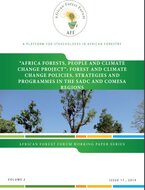
The vulnerability of rural households to climate change in Africa is caused by exposure to climate variability and extreme weather events and by a combination of social, economic and environmental factors that interact with climate change. There is growing evidence that climate change is affecting forests resources in Africa. The effect on the forest resource is mainly as a result of vulnerable communities adapting to climate change through the use and in some cases over use of the forestry goods and services. Since the Kyoto Protocol and several COP Agreements, the role of forestry and trees in a landscape in general in addressing climate change through mitigation and adaptation has gathered pace. This was initially through the promotion of conservation of forests and woodlands as a means of reducing emissions especially carbon dioxide. However, there is increasing understanding that there is an intrinsic link between people and the forest landscape as forests go beyond safety net in addressing the livelihoods of communities in proximity as well as ecosystem services including climate change. The appreciation of forest-based interventions to address climate change adaptation and mitigation has gained attraction; and has been identified by the IPCC including trees in a multifunctional landscape. As a result, a number of donor funded development programme and projects were initiated in Africa response of climate change.

Publication Downloads

🌐 Bilingual Edition · English & French Available

Access and download the official document in available languages.

🇬🇧 EN

English Edition

PDF Document · 1.5 MB

Download PDF
🇫🇷 FR

Édition Française

Document PDF

Télécharger PDF
Publication Type
Working Paper
Keywords
Biofuels Biofuel production Sugarcane Ethanol
Bilingual Publication • Édition Bilingue

This publication is officially available in both English and French (Français) editions.

Available Downloads

Abstract

The African Forest Forum (AFF) has undertaken studies in four African sub-regions to assess the potential of selected African countries to produce and use of liquid biofuels as a strategy for developing green and circular economies. The sub regions are eastern, southern, central and western Africa. This report is on three eastern Africa countries namely of Ethiopia, Kenya and Tanzania. Then the outputs of this study are expected to facilitate planning the growth and development of local and national liquid biofuel sector based on information and data obtained from field and factory visits, interviews and discussions with some national government and Non-Governmental Organizations (NGOs), and other stakeholders related to the liquid biofuel industry. Liquid biofuels commonly available in eastern Africa are bioethanol and biodiesel produced from higher plants, though there was ongoing research on liquid biofuel from microalgae. In Ethiopia, land highly suitable for production of feedstock was estimated that 7.2 million ha (6.3%) for jatropha, 7.68 million ha (6.8%) for croton, 11.47 million ha (10.2%) for cassava, 40.91 million ha (36.2%) for sweet sorghum, and 0.7 million ha (0.62%) for sugarcane. In Kenya, 17.4 million ha (30.6%) land area was suitable for sweet sorghum, 6.39 million ha (11.2%) for cassava, 1.26 million ha (2.2%) for sugarcane, and 14.9 million ha (26.2%) for jatropha. In Tanzania, the suitable land area is 22.79million ha (22.9%) for cassava, 18.96million ha (21.5%) for sugarcane, 31.51million ha (35.8%) for sweet sorghum, and 17.78million ha (20.2%) for sunflower. Investments in liquid biofuel production in the years 2010s were not profitable, resulting in investors abandoning investments on feedstocks like jatropha and related biodieselcrops. The only investment that remained was the already well-known sugarcane production mainly for sugar and molasses bioethanol. The use of sugarcane for the production of biofuels has been observed in13 sugar factories in Ethiopia, 16 sugar factories in Kenya, and five sugar factories in Tanzania. The reported annual production of ethanol was 24.25 million liters in Ethiopia, 8.25 million in Kenya and 1.4 million in Tanzania from one or two sugar factories. Improving productivity of sugarcane by increasing the yield to 138 tons or more per hectare, combined with improvement in technology by reducing wastage in molasses, and ethanol production, could enable the existing Ethiopian sugarcane factories to produce in full capacity at 432.41 million liters of ethanol per year, and those in the Kenyan at 289.28 million liters/year and the ones in Tanzanian at 81.64 million liters/year, when operating on an average of 250 working days/year. The production costs for conventional liquid biofuels are mainly the feedstock costs that account for 60-90% of the total production cost. This has given rise to the use of cheap sources such as lignocellulosic biomass waste, agricultural residues, and sugarcane bagasse. These were reported to vary annually from about 2.2 million tons of agricultural residues in Kenya, to 19.7 million tons in Ethiopia, in addition to 24.2 million tons of woody biomass residues in Kenya to 105.2 million tons in Ethiopia that could be used for lignocellulosic bioethanol production. From lignocellulosic biomass processing, the total bioethanol production could reach 8.2 billion liters/year in Kenya, 10.8 billion liters in Tanzania to 35.7 billion liters/year in Ethiopia, which is higher than their imports of petroleum. Bio-oil (pyrolysis oil) is another liquid biofuel that can be obtained by burning biomass at 400 to 1000°C under limited oxygen environment. Pyrolysis oil producing biomass includes eucalyptus species, in addition to other biomass resources. Microalgae oil is identified as a potential biodiesel feedstock in Ethiopia, Kenya and Tanzania as these tropical countries have favorable climatic conditions. Microalgae are promising liquid biofuel feedstock due to its rapid growth rate and many times harvest, and without taking up land under food crops or forests. Microalgae can produce 11,238litres biodiesel per hectar per year, which is higher than the 150litres biodiesel from a hectare of jatropha and higher than the 700 liters of ethanol in a hectare of sugarcane. The use of ethanol for cooking at household level reduces emission that can be created by solid biomass fuel including 99.8% of particulate matter created by burning solid biomass in three stone stoves and 91.0% of that created by wood/charcoal Rocket Combo stoves. Improving the E15 in Ethiopia could have an abatement potential of 0.2 Mt CO2e in 2030. In Kenya, adoption of low carbon using biodiesel has an abatement potential of 1.2 MtCO2e. Tanzania has a commitment to reduce greenhouse gas emissions economy-wide between 138 - 153 MtCO2e by 2030 by promoting clean technologies. The eastern Africa national governments ambitious plans to produce liquid biofuel had minimal achievements because of institutional, market, technical and legal challenges. Many of these can be overcome by providing comprehensive support for out growers, supporting seed production and diversifying feedstock, in addition to providing training and financial incentive, as well as researching different types of feedstocks that have high yield. There are also needs to improve water use efficiency in production and providing supportive/enabling policies. Also, the liquid biofuel investment in eastern Africa had adversely affected crop land in many places because it was not based on pre-assessment of land-use. Much as there was and continues to exist good potential domestic and foreign markets for liquid biofuel, the failure on the initial biofuel production investment resulted in idleness of land that was allocated to production of feedstock and supporting infrastructure, mistrust between local people who lost land and the investors, and loss of labor. That notwithstanding, given the new impetus on renewable energy, forestry and agricultural professionals should aggressively continue researching on appropriate and productive bioenergy crops.

Publication Downloads

🌐 Bilingual Edition · English & French Available

Access and download the official document in available languages.

🇬🇧 EN

English Edition

PDF Document · 2.2 MB

Download PDF
🇫🇷 FR

Édition Française

Document PDF

Télécharger PDF
Publication Type
Report
Keywords
Biomass Woodlands Species Trees
Bilingual Publication • Édition Bilingue

This publication is officially available in both English and French (Français) editions.

Available Downloads

Abstract

Globally, belowground biomass (BGB) accounts for 20–26% of total biomass, and as such it is an important carbon (C) pool for many vegetation types. However, large uncertainty exists for belowground biomass C compared to aboveground stocks. Using data from 108 destructively harvested trees belonging to 36 miombo species, we estimated root to shoot ratios, and developed models for estimation of aboveground biomass (AGB), BGB and total biomass C stocks in the Copperbelt province of Zambia. We also validated our models using independent datasets from elsewhere in Zambia and Malawi. The C fractions in wood ranged between 51.9 and 58.9%, which was higher than the IPCC default value. The root to shoot ratio was found to be 0.303. The analysis also demonstrated isometric scaling of BGB with AGB. According to cross-validation results, the model that incorporated wood density (ρ), diameter at breast height (D) and total stem height (H) formulated as AGB =0.093(ρD2H)0.97 *1.08 outperformed existing models developed for the miombo woodlands in Zambia. The best model for BGB was BGB = 0.476(AGB)0.88*1.126. Using the top-ranked models, the stand-level AGB stocks were estimated at 222.2 Mg ha−1, while BGB stocks were estimated at 52.4 Mg ha−1. Aboveground and belowground C stocks were 125.3 Mg ha−1 and 29.5 Mg ha−1, respectively. Total biomass C stocks were estimated at 152.1 Mg ha−1 or 558.3 Mg ha−1 CO2 equivalent sequestered in tree biomass. These estimates may be used as baseline data for future carbon management and for emerging payment for ecosystem services projects in miombo woodlands.

Publication Downloads

🌐 Bilingual Edition · English & French Available

Access and download the official document in available languages.

🇬🇧 EN

English Edition

PDF Document · 2.6 MB

Download PDF
🇫🇷 FR

Édition Française

Document PDF

Télécharger PDF
Publication Type
Working Paper
Keywords
Charcoal Deforestation Forest
Bilingual Publication • Édition Bilingue

This publication is officially available in both English and French (Français) editions.

Available Downloads

Abstract

The global advancement and investments in biofuels production, consumption and trade are widely regarded as offering environmentally-sustainable solutions to reducing harmful greenhouse gases (GHG), poverty reduction, food and energy security, rural development and employment in developing countries. However, biofuels may also lead to food insecurity, environmental degradation, loss of biodiversity habitat, human displacement; land use and land cover change in situations where policy and institutional frameworks are poor. It is against this background that the AFF instituted this study to investigate and understand the biofuels industry in the selected countries of southern Africa namely: Madagascar, Malawi, Zambia and Zimbabwe, its interplay within the nexus food-fuel-fibre (3Fs), as influenced by the existing policy and institutional frameworks. Specifically, this study sought to address the following key result areas:

Publication Downloads

🌐 Bilingual Edition · English & French Available

Access and download the official document in available languages.

🇬🇧 EN

English Edition

PDF Document · 2.9 MB

Download PDF
🇫🇷 FR

Édition Française

Document PDF · 2.9 MB

Télécharger PDF
Publication Type
Policy Brief
Keywords
Forest Forestry
Bilingual Publication • Édition Bilingue

This publication is officially available in both English and French (Français) editions.

Available Downloads

Abstract

The African Forest Forum (AFF) in a study on professional forestry associations in southern Africa found out that a majority of formerly active professional forestry associations have gone moribund for several reasons. However, South Africa is the exception in that it has a number of active forest related associations that are backed by a vigorous industrial base. They are well placed to influence public policies in support of the forestry sector. In addition, several countries including Mozambique, Zambia and Zimbabwe have associations of producers, traders and manufactures of forest products. Despite this, there is tremendous interest in virtually every country to strengthen, revive or establish new professional forestry associations; largely motivated by the income generation and poverty reduction 'policy push' in virtually every country; and more recently, the new opportunities in forestry to reduce CO2 emissions under REDD+ (Reducing Emissions from Deforestation and forest Degradation) and Clean Development Mechanism (CDM) schemes. The AFF considers it an opportune moment to strengthen, establish or revive both professional and industry associations in a continent that is increasingly becoming aware of the potential role of forests and trees, their contribution to national incomes, livelihoods, and stability of the environment.  

Publication Downloads

🌐 Bilingual Edition · English & French Available

Access and download the official document in available languages.

🇬🇧 EN

English Edition

PDF Document · 180 KB

Download PDF
🇫🇷 FR

Édition Française

Document PDF · 180 KB

Télécharger PDF
Publication Type
Working Paper
Keywords
Charcoal Climate change Forest Deforestation
Bilingual Publication • Édition Bilingue

This publication is officially available in both English and French (Français) editions.

Available Downloads

Abstract

The global advancement and investments in biofuels production, consumption and trade are widely regarded as offering environmentally-sustainable solutions to reducing harmful greenhouse gases (GHG), poverty reduction, food and energy security, rural development and employment in developing countries. However, biofuels may also lead to food insecurity, environmental degradation, loss of biodiversity habitat, human displacement; land use and land cover change in situations where policy and institutional frameworks are poor. It is against this background that the AFF instituted this study to investigate and understand the biofuels industry in the selected countries of southern Africa namely: Madagascar, Malawi, Zambia and Zimbabwe, its interplay within the nexus food-fuel-fibre (3Fs), as influenced by the existing policy and institutional frameworks. Specifically, this study sought to address the following key result areas:

Publication Downloads

🌐 Bilingual Edition · English & French Available

Access and download the official document in available languages.

🇬🇧 EN

English Edition

PDF Document · 2.9 MB

Download PDF
🇫🇷 FR

Édition Française

Document PDF · 2.9 MB

Télécharger PDF